Hi! Since it's now 2011, I'm going to do something special, i.e., a quiz! So, today, I'm going to give you a quiz. It has 10 questions, and covers comic strips as well as comicbooks, so be prepared!
1. This is an easy one: What is Superman's usual secret identity?
2. In the comic strip Big Nate, what is Nate's middle name?
3. In the Legion of Superheroes, what person became a Legionnaire during the Fatal Five's second appearance?
4. Who died in Amazing Spider-Man #121? (Hint: It's infamous)
5. How many issues of Fantastic Four did Stan lee and Jack Kirby produce together?
6. In the Legion of Superheroes, Phantom Girl comes from:
a) The planet Bgztl, in the fourth dimension
b) The planet Bqztl, in the sixth dimension
c) The planet Bqtl, in the fourth dimension
d) The city Bgztl, in the fourth dimension
7. In the comic strip FoxTrot, what is the name of Jason's pet?
8. How fast can Superman fly, according to The Ultimate Guide to the Man of Steel by Scott Beaty?
9. 344 Clinton Avenue is the Silver Age home of what superhero?
10. Last question! In Flash No. 228, in the seventh panel of the seventh page, what did Barry Allen say?
Answers
_______________________________________________
1. This is an easy one: What is Superman's usual secret identity?
Answer: Clark Kent.
2. In the comic strip Big Nate, what is Nate's middle name?
Answer: Trick Question! He has no middle name!
3. In the Legion of Superheroes, what person became a Legionnaire after the Fatal Five's second appearance?
Answer: Shadow Lass.
4. Who died in Amazing Spider-Man #121 (Hint: It's infamous)
Answer: Gwen Stacy.
5. How many issues of Fantastic Four did Stan lee and Jack Kirby produce together?
Answer: 102, plus one cover.
6. In the Legion of Superheroes, Phantom Girl comes from:
a) The planet Bgztl, in the fourth dimension
b) The planet Bqztl, in the sixth dimension
c) The planet Bqtl, in the fourth dimension
d) The city Bgztl, in the fourth dimension
Answer: a, The planet Bgztl, in the fourth dimension.
7. In the comic strip FoxTrot, what is the name of Jason's pet?
Answer: Quincy.
8. How fast can Superman fly, according to The Ultimate Guide to the Man of Steel by Scott Beaty?
Answer: Nobody knows.
9. 344 Clinton Avenue is the Silver Age home of what superhero?
Answer: Superman!
10. Last question! In Flash No. 228, in the seventh panel of the seventh page, what did Barry Allen say?
Answer: "But... Why tell me? I just work in the police lab!"
Congratulations! You just completed the quiz! I hope you got the right answers. Bye!

Friday, December 31, 2010

Monday, December 27, 2010
Oops!
Hi! Today, after Christmas, I'm going to tell you how, shockingly, there was a mistake in a comicbook! And, when it was written about in the letters pages, unlike some letters that were explained away, like this one I found on my favorite blog

replied like this:
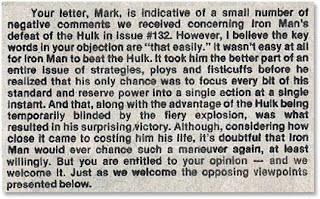
So, here's the letter, from a cool website I found:
Dear Editor: In "The 100 New Feats of Superboy," the Boy of Steel says, "And while I've often endured the sun's heat of 20 billion degrees, I've never visited this star, the hottest in the universe - over 10 billion degrees." I'm sure this is a 100% goof! -Bob Rozakis, Elmont, N.Y.
(Oops! It looks like the Bizarros got some of their whacky mathematics into this story, too! Seriously, the sun's heat should have been given as 20 million degrees. -Ed.)
If you find any more goofs in comics, please let me know in the comments. Bye!

replied like this:

So, here's the letter, from a cool website I found:
Dear Editor: In "The 100 New Feats of Superboy," the Boy of Steel says, "And while I've often endured the sun's heat of 20 billion degrees, I've never visited this star, the hottest in the universe - over 10 billion degrees." I'm sure this is a 100% goof! -Bob Rozakis, Elmont, N.Y.
(Oops! It looks like the Bizarros got some of their whacky mathematics into this story, too! Seriously, the sun's heat should have been given as 20 million degrees. -Ed.)
If you find any more goofs in comics, please let me know in the comments. Bye!
Sunday, December 12, 2010
25th Post!
Hi! As you know, this is my 25th post on Evan's Library! This calls for hoopla! This calls for celebration! Well, maybe I'm exaggerating it a little. But still, since I've done 1/4 of a hundred posts, I'm going to do something special. And what better special thing to do than write an essay about the Silver Age of comics? Here it is:
All About the Silver Age of Comics
The Golden Age of comics was over, and it was the middle of the Atom Age, where instead of superheroes, comics were mostly horror and western. But, in October 1956, it all changed. Showcase #4 featured the reappearance of the Flash, this time as Barry Alllen, and kicked off the Silver Age of comics!
The Flash wasn't the only one to be revived. Green Lantern came back, also different this time. There were some people who came back, but were the exact same people, albeit with a few differences, such as Superman, Batman, and Wonder Woman. (She had actually never disappeared.)
The artwork was different too. Instead of the kind of crude drawing in the Golden Age, Silver Age artwork was somehow pretty realistic, yet pretty cartoony at the same time. Here's a sample of Silver Age DC Comics art:

DC wasn't the only comic publisher that took part in the Silver Age. Marvel also got into it by creating the Fantastic Four, Thor, the Hulk, Captain America, Spider-Man, and much, much, more. Also, Stan Lee teamed up with Jack Kirby, forming what is arguably the best team in comics history, second only to the most important one, Jerry Seigel and Joe Schuster, and they created one hundred and one Fantastic Four comicbooks and the cover of Fantastic Four # 102 STRAIGHT. To quote Comic Books 101 by Chris Ryall and Scott Tipton, “DC's flash may have kicked of the Silver Age, but Marvel owned it.”
Here's a sample of Silver age Marvel art:

Chris Ryall and Scott Tipton were right.
But, all good things had to come to an end. The thing is, no wide agreement on when it ended has been made. There are a few different theories, but I think it happened with Amazing Spider-Man # 121 in 1973, also known as the DEATH of Gwen Stacy. A lot of people agree with me.
Well, now you know all about the Silver Age of comics! Now, on to section two of my 25th post, recommended reading!
25 Comicbooks on MY Recommended Reading List
(Not necessarily in this order.)
1.Comic Books 101
2.Showcase Presents Superman, Volumes 1-3
3.The DC Encyclopedia
4.Marvel Encyclopedia 2009
5.Marvel 70th Anniversary Collection
6.Marvel Masterworks: Fantastic Four, Volume 6
7.The Best of Foxtrot
8.Big Nate Strikes Again
9.DC's Greatest Imaginary Stories
10.DC's Greatest Imaginary Stories Featuring Batman and Robin
11.Garfield: 25 Years and Still Kicking!
12.The Greatest Batman stories Ever Told
13.The Calvin and Hobbes Tenth Anniversary Collection
14.Showcase Presents Dial “H” for Hero
15.Essential Fantastic Four, Volume 3
16.Tales to Astonish No. 13 tied with
17.The Kid who Collects Spider-Man
18.Amazing Adult Fantasy No. 10
19.All Star Comics No.3
20.Superman No. 141
21.Amazing Spider-Man No. 30-33
22.Avengers No. 4 (1998)
23.Fantastic Four No. 52
24.Adventure Comics No. 357
25.Superman No. 162!
Yes, I know numbers one, three, four, and eight aren't technically comicbooks, but they're close enough. NEXT up is an infomercial for my favorite blog of all time!
Do you like comics but don't know much about them?
Do you like the idea of blogs, but don't like them to be too much about the author?
Then you would love the (discontinued) blog...
COMICS COVERAGE!
Created by Mark Engblom, Comics Coverage is a blog almost all about comics with three YEARS worth of posts under its belt! Though it isn't active anymore, it's still great! Use your computer today to visit the blog... Comics Coverage!
And that's my 25th post! Adios!
Comicbooks Collections
Hi! Today, I'm going to talk about different types of comicbook collections, and their advantages and DISadvantages. Here it is:
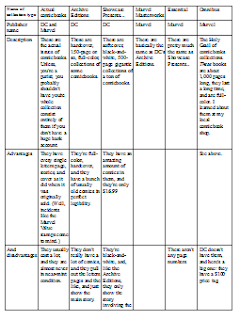
Adios!
-Evan
P.S. Next up is my celebratory 25th post!
_______________________________________________________________________________________
Update: A librarian said that he got some Omnibuses when he was a librarian at a middle school, and he has two complaints about them:
1 The binding weren't very durable, and the books fell apart after something like three readings, and
2 They were really thick.
So, maybe the Omnibuses aren't so great!
Thursday, December 2, 2010
Severely damaging the fourth wall
Hi! Today, I'm going to talk about how some comics have been "leaning on the fourth wall". I got the idea from a website.
First off, we have the category of comic strips. In the last week of FoxTrot dailies, it was all about how "some cartoonist" was switching to Sundays only. The most damage to the wall was done in the very last daily, when Roger said "The opportunity to do a comic strip that millions of people read every day is a rare and special privilege. This guy had better thank the newspapers and readers that stuck with him and made it possible. Maybe he'll do something like that in the strip." Andy's reply is
"And break the fourth wall? Not likely."
Also, on Garfield's 25th birthday, Garfield thanked the readers. And in another strip, he "talked" to the reader. Stone Soup also said that you could wear PJ's at Joan and Wally's wedding, and had an invetation in their strip.
There was also a one-week FoxTrot story arc, where an Peter and Jason were wondering how cartoonists do their strip when they're sick, and for each suggestion Peter came up with, it actually happened to him. (e.g. "Did you hear what Dan Quayle saidon Carson last night?" when he said that cartoonists had reserve jokes.) In another strip, Jason was wondering if anything would go wrong with comic strips at Y2K, since so many carttonists used computers with their work, and Peter said "What could go wrong in a comic strip?" As he and Jason suddenly transformed into characters from the early 1900's. There was also a FoxTrot one that involved the Washington Post, but I didn't get it.
In Bloom County, however, there is no fourth wall. All the characters know they're just part of a comic strip. (And yet, Bill and Opus still run for office.) They actually had a strike for bigger strip sizes once.
Now, we have comicbooks. In the DC Universe, before the infamous (at least, to ME) Crisis on Infinite Earths, they have the fourth wall in an interesting way. In their Earth, they're quite real, but, this world is called Earth-Prime, and their dimensional counterparts are just fictional. My favorite Earth-Prime story is When I Flew With Superman! by Curt Swan.
The Marvel Universe in the Silver Age also had an interesting fourth wall. The superheroes were real, but the ones without secret identities had comicbooks about them published, thanks to good ol'Marvel. I'm not sure if the Silver Surfer wanted that to happen or not.
In one Uncle $crooge comicbook, Scrooge McDuck had a bunch of actual Carl Barks paintings, and said he was his favorite artist, and Donald Duck said something like they looked like scenes from nutty children's comics.
And that's how some comics leaned on the fourth wall! Adios!
P.S. Tune in in two posts for my 25th post!
Thursday, November 25, 2010
A History of Thanksgiving
Hi! as you can guess from my title, since it's the third Thursday of November, I'm going to tell you a history of Thanksgiving. I just finished Thanksgiving dinner, and I enjoyed it. Anyway, here it is, and please excuse any typos.
A History of Thanksgiving
By Evan
In 1620, England was still a total monarchy and America hadn't been founded yet. In fact, only a few people had visited it so far! And England had no first amendment that America would have in 1791. That meant, among other things, there was no such thing as religious freedom in England. King George ruled all, and was in complete control.
So, a large amount of people wanted to move to America to worship whoever they chose. But wait! There was a problem! The journey to America would be a long and dangerous one, and what if the natives were hostile to them? They were OK to, say, Christopher Columbus from Spain, who had “discovered” America 128 years ago, but that didn't necessarily mean they would be to the Pilgrims. So, only the fit men and women went, and the kids and older people stayed. If America was safe, the people who had made the journey would come back and everyone else would go.
But there was another problem. They needed money for a ship, and one large enough for a 3,000 mile trip cost a lot. So they borrowed a ship! They would pay back the company they borrowed it from with any riches they found in America, keeping only enough for themselves to live.
And the journey was a hard one. It was crowded and cramped, and, believe it or not, some people kept skunks as pets! And they preferred to eat in the dark because their food was crawling with bugs.
Finally, though, they arrived in Plymouth Harbor! The natives were pretty friendly, and a few even spoke English! There were a few drawbacks, as well. They (the Pilgrims) never had time to sit down for dinner, and that's assuming they even HAD enough food for dinner! They could barely catch any animals, so they had to trade items such as knives to the Native Americans for venison.
Luckily, named Squanto taught them how to plant corn Indian-style. They learned to fertilize the seeds with haddock. However, there was a drawback to that, too. The rotting haddock attracted wolves, and they couldn't dig up the fish, because that would ruin they corn, so kids had to guard them (the corn) by throwing rocks at any wolves that came near.
Fortunately, after the first few years, their life got better, and they celebrated by having a huge feast. They invited just about everyone in the colony and the chief of the nearby natives that had helped them. What they didn't know was that 90 other Indians were coming along with him! But the Indians realized the problem, and captured nine deer. Problem solved! And that dinner was the first Thanksgiving.
In the early 1900's, though, Thanksgiving was kind of dying out. It wasn't a national holiday yet, and pretty much only the people in the East Coast celebrated it. And Sarah O'Hale did not like that. She wrote letters to James Buchanan, the current President, but he had more important matters to worry about. But, when Abraham Lincoln succeeded him, Sarah wrote 13 letters, and finally, he agreed. Thanksgiving was made an official national holiday!
And that's the history of Thanksgiving! Bye!
P.S. Stay tuned for my 25th post in 3 more posts!
Wednesday, November 17, 2010
The Best of Foxtrot Post No. 2
Hi! As you can recall from my earlier post, a comicbook called The Best of FoxTrot was going to come out. Well, it did, and I, yes, I have my own copy! And, I'm giving it a five-star review! in five categories, I'll describe the new Foxtrot book! Here it is:
Category No. 1: Strip selection Fantastic! Bill Amend did an incredible job of picking the best ones. It has everything from the longest storyline ever, (Camp Bohrmore)to the most touching, (When Peter gets sick on Thanksgiving) to, 'course, the first one, to my personal favorite! (When Paige can't figure out what Jason and Marcus see in comicbooks.) My only complaint in that category is that he left out the second appearance of Phoebe!
Category No. 2: Organization This category was only so-so. While the years were in the right order, and the strip story arcs were too, the months and dates were kind of jumbled. But, on the other hand, as I said, you wouldn't find a 2002 strip before 1999.
Category No. 3: Special features I notice that most of the Foxtrot anthologies have an "extra" in it, like the smaller Garfield collections. Well, this book didn't let me down. Aside from the obvious selection of strips, there was also an introduction, AND there was a slipcase cover to house the two volumes. So, in that respect, it was pretty good.
Category No. 4: Annotations as I said in my previous post, mentioned above, there's annotations by Bill Amend in the book,kind of like The Calvin and Hobbes Tenth Anniversary book. Well, while they weren't as plentiful as the ones in Seven years of Highly Defective People by Scott Adams, they are pretty informative and they are by Bill himself.
Category No. 5: Overall To conclude this post, I'm going to write an overview.
Strip selections: 4 3/4 out of five stars.
Organization: 2 1/2 out of 5 stars
Extras: 4 out of five stars
Annotations: 4 out of five stars
I also award the book another 2 points for sheer funniness of the strips. The oldest one in there ran more than two decades ago!
Final score: 17.25 out of 20 stars
So, not bad at all! And to bring the number of words in this post to an even 400, aloha!
Subscribe to:
Posts (Atom)